Classic Coulter Principle
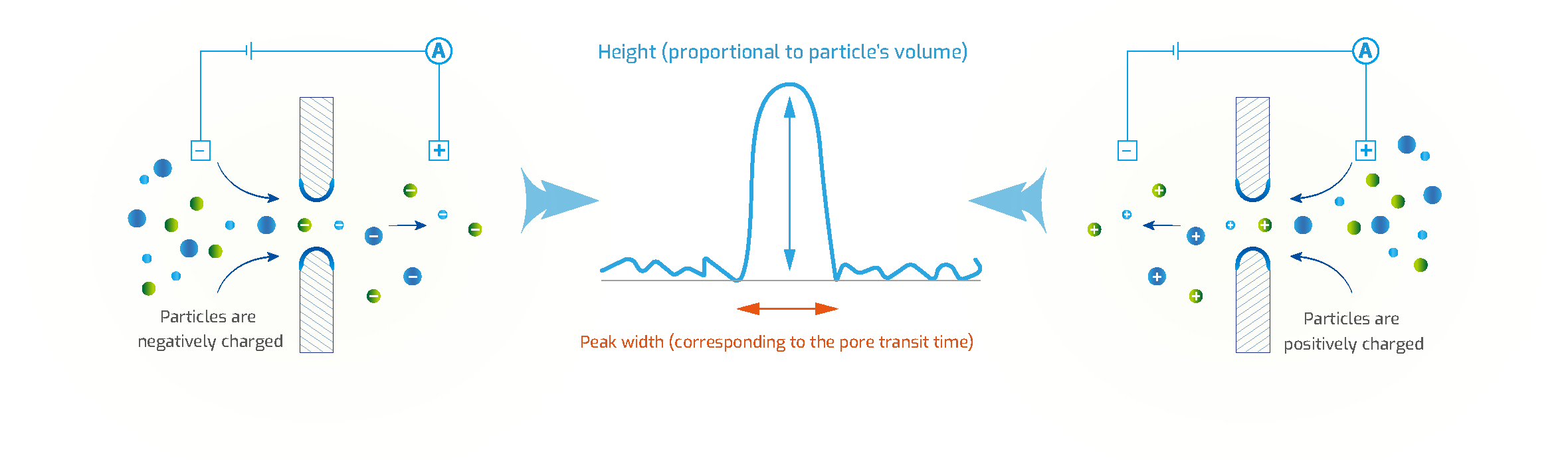
NanoCoulter™ utilizes the resistive pulse sensing (RPS) principle, also known as the Coulter principle. When the voltage is applied in the electrolyte, as individual particles traverse the nano-aperture of the NanoCoulter™ N-Chip™, a transient change in electrical resistance is generated, forming a resistive pulse. These resistive pulses are accurately analyzed by NanoCoulter™ to yield multi-dimensional data, including particle size, concentration, and Zeta potential.
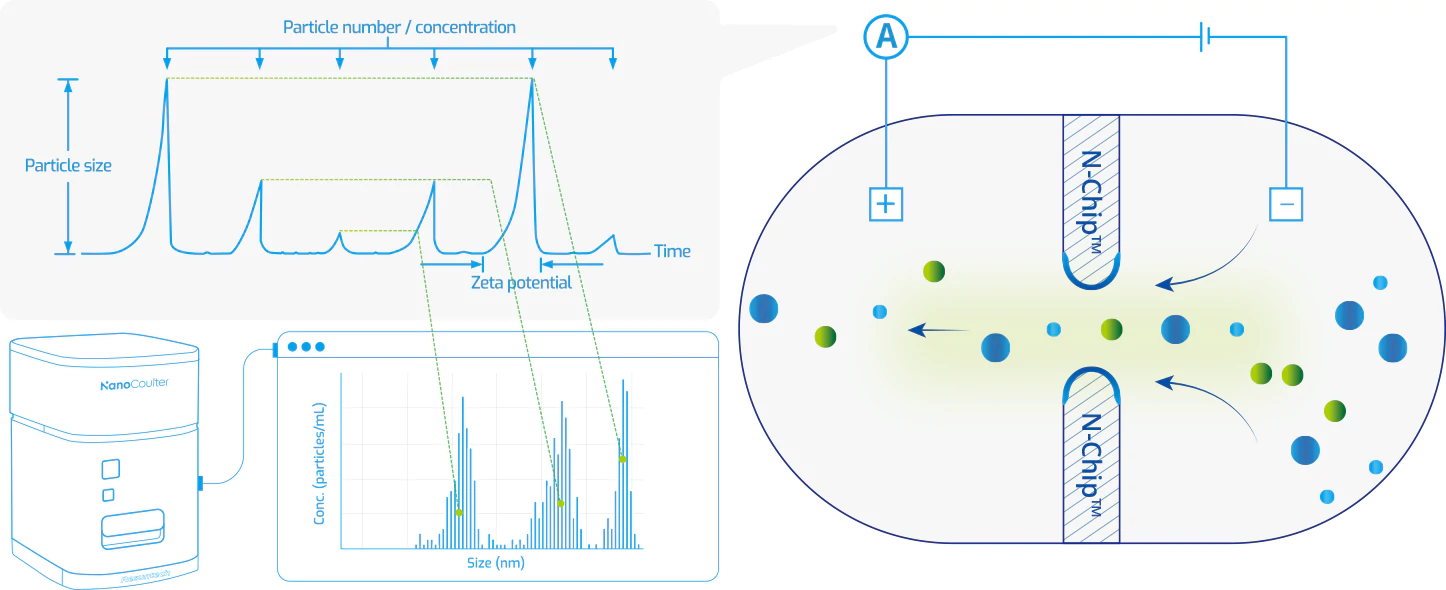
When particles are subjected only to the electric field force, their electrophoretic migration velocity is proportional to their surface charge, which is quantified as the Zeta potential.
Under the action of an applied electric field, charged particles move toward the electrode of opposite charge, and their migration velocity is related to the magnitude of the Zeta potential.
How It Works?
Why Choose NanoCoulter?
True Particle-by-particle Detection
Precise analysis of polydisperse or heterogeneous samples as each particle passes through the nano-aperture.
Multifunctional
All-in-one high-resolution analysis of single-particle size, concentration, and zeta potential.
Super Accuracy and Precision
Highly linear concentration measurements (R²> 0.999) and consistently low CV% across all tests.
High Resolution and Sensitivity
1 nm particle size resolution for high-precision applications - comparable to TEM.
True-to-sample Results
Unaffected by optical properties of particle, delivering non-fitted, highly accurate data reflecting the true state of samples.
Easy to use
Pre-calibrated chips with simple, maintenance-free operation and user-friendly software. No washing, clogging, or calibration needed.
Beyond the Limits of Optical DLS and NTA
100/150/200 nm
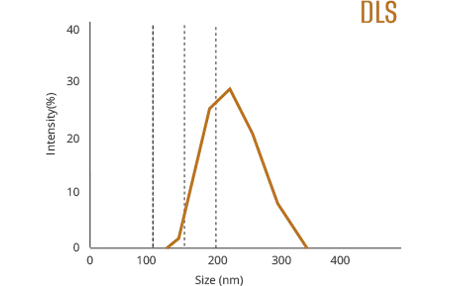
DLS cannot accurately measure polydisperse samples, causing size deviations and failing to determine particle concentration.
100/150/200 nm
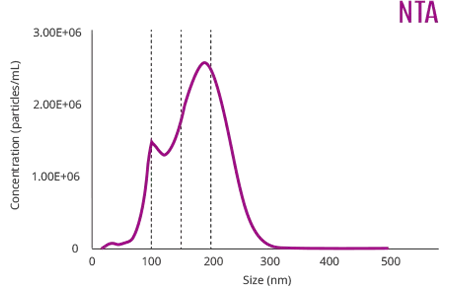
NTA could discern the bimodal
mixture but not the trimodal or quadrimodal mixture.
80/120/160/200 nm
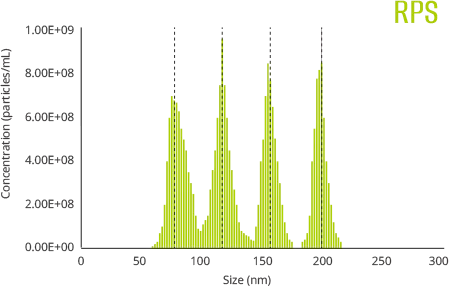
RPS differentiates multimodal
mixtures with high resolution, measuring actual diameter without prior particle knowledge.
Latest Articles & News