
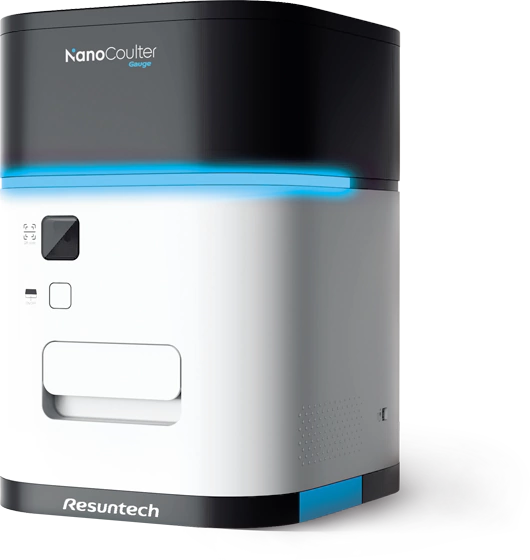
NanoCoulter™ Gauge simultaneously obtain multi-dimensional data on particle size, concentration, and zeta potential in a single measurement.
Unparalleled Detection Performance
Electron Microscopy-Comparable Particle Size Determination
NanoCoulter™ measures both the particle size and size distribution of polydisperse samples, delivering EM-consistent results with exceptional accuracy and precision.


Measure Concentration with High Accuracy and Repeatability
Samples were serially diluted, and the concentration detection data demonstrated a strong linear correlation with the theoretical concentration (R² > 0.999). Across 10 repeated measurements, the coefficient of variation (CV) was less than 5%.


Single-Particle Zeta Potential Measurement
Zeta potential is an important indicator of the stability of dispersion systems. Under a constant electric field, the electrophoretic velocity of particles is directly proportional to the absolute value of their zeta potential. NanoCoulter™ measures the time it takes for particles to pass through a nanopore to obtain Zeta potential data, making it the only technology platform capable of simultaneously measuring single-particle size, Zeta potential, and concentration.


Related Cases
MISEV Recommends RPS for EV Characterization
“RPS measurements do have very high concordance with TEM data.” —MISEV 2023
RPS technology, a non-optical method, well suited for orthogonal validating against TEM and flow cytometry. NanoCoulter™ offers accurate size distribution analysis with a defined LOD (50nm) and a wide concentration range (5×10⁷-2×10¹¹ particles/mL), making it indispensable for EV research.”


Investigation of EV Isolation Methods
Exosomes have complex origins and often require multiple isolation steps to obtain relatively pure exosomes. Different isolation methods can significant impact on the particle size and concentration of exosomes. The NanoCoulter™ enables rapid and accurate assessment of the advantages and disadvantages of different purification methods.

EV Zeta Potential Characterization
Zeta potential is a key parameter for evaluating EV stability, surface charge characteristics, and in vivo interactions. It directly influences adsorption, targeted delivery, and circulation time within biological systems. Traditional optical methods (DLS/LNT),can only provide an ensemble-averaged potential, failing to capture sample heterogeneity. NanoCoulter™ enables single-particle Zeta potential measurement, offering precise insights into EV population heterogeneity, thereby advancing research and applications in EV-based therapeutics.


Batch-to-Batch Variation Control in Adenovirus Production
Cell culture conditions, including medium composition, temperature, and pH, influence adenovirus production efficiency. NanoCoulter™ enables real-time monitoring of virus concentration, size distribution, and Zeta potential, facilitating rapid batch assessment and process optimization.


Poxvirus Particle Aggregation Analysis
The storage conditions of viruses have a significant impact on their degree of aggregation. Excessive aggregation can reduce the infectivity of the virus. The NanoCoulterTM possesses extremely high particle size resolution and is the only technology besides electron microscopy capable of accurately analyzing virus aggregation. In the distribution plots of poxvirus particles under two different storage conditions shown below, the virus particles under Condition 2 exhibit significantly better dispersion.


Liposome Stability Study
The stability of liposomal drugs directly affects their storage and in vivo delivery performance. The NanoCoulter™ enables precise evaluation of stability differences among various liposomes. The figure below shows the concentration changes of two liposome samples after different durations of simulated agitation, indicating that Sample 2 exhibits superior stability.


LNP Particle Size Distribution and Zeta Potential Analysis
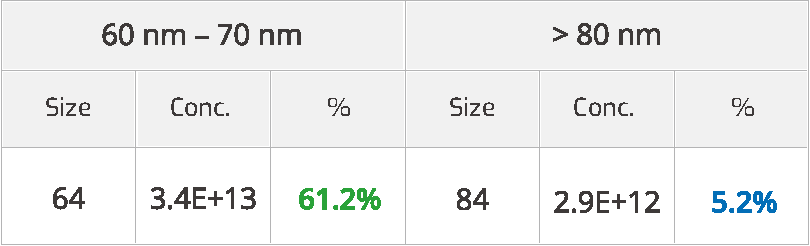
Particle size and size distribution are among the key Critical Quality Attributes (CQAs) parameters for LNPs. LNPs prepared by different methods may exhibit different size distributions, which are often overlooked by DLS measurements. The
NanoCoulter™ can resolve the size distribution of LNP particle populations while providing concentration and component proportions within user-defined size ranges, along with the correlation between Zeta potential and particle size for each individual nanoparticle.



Magnetic Nanoparticles
The uniformity of magnetic beads is one of their key parameters. However, since they are prone to aggregation, ultrasonication is usually required to achieve effective dispersion. The NanoCoulter™ can accurately measure the particle size and concentration of magnetic beads, allowing for intuitive evaluation of the dispersion efficiency of different ultrasonic methods. Among the three different ultrasonic treatment methods shown in the figure below, Method A can disperse the magnetic beads more effectively, resulting in a more uniform overall distribution.


Magnetic Nanobeads & Microspheres
NanoCoulter™ enables precise analysis of nanosphere size and Zeta potential changes before and after antibody coating, effectively monitoring aggregation. Ultrasonication or other treatments can be used to address this issue.


Latest Articles & News