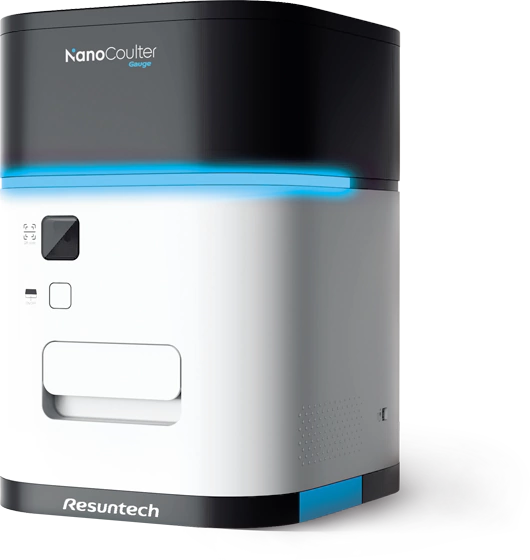
NanoCoulter™ Gauge simultaneously obtain multi-dimensional data on particle size, concentration, and zeta potential in a single measurement.
Unparalleled Detection Performance
Particle size measurement precision comparable to electron microscopy
The NanoCoulter™ measures the average particle size and size distribution of polystyrene standard microspheres and other polydisperse samples,producing results that are fully consistent with SEM data, offering exceptionally high accuracy and precision.
Measure concentration with high accuracy and repeatability
Samples were diluted in a gradient, and the concentration detection data showed a good linear relationship, consistent with the theoretical concentration(R² > 0.99). With 10 repeated tests, the coefficient of variation (CV) was less than 5%.
Single-Particle Zeta Potential Measurement
Zeta potential is an important indicator of the stability of dispersion systems. Under a constant electric field, the speed at which particles move is positively correlated with the absolute value of the Zeta potential. NanoCoulter™ measures the time it takes for particles to pass through a nanopore to obtain Zeta potential data, making it the only technology platform capable of simultaneously measuring single-particle size, Zeta potential, and concentration.
Related Cases
MISEV Recommends RPS for EV Characterization
“RPS measurements do have very high concordance with TEM data.” —MISEV 2023
RPS technology, a non-optical method, is ideal for orthogonal validating TEM and flow cytometry. NanoCoulter™ offers accurate size distribution analysis with a wide detection range (50-800 nm) and concentrations (5×10⁷-2×10¹¹ particles/mL), making it indispensable for EV research.”
Exosome Zeta Potential Characterization
Exosome zeta potential is a key parameter for evaluatingcolloidal stability, surface charge properties, and in vivointeractions, directly influencing adsorption, targeteddelivery, and circulation time in biological systems.Optical methods (DLS/NTA) typically provide only ensemble-averaged zeta potential, while NanoCoulter enables single-particle zeta potential measurement, offering preciseinsights into exosome population heterogeneity. Thisbreakthrough enhances research and applications inexosome-based therapeutics.
Batch-to-Batch Variation Control in Adenovirus Production
The composition of the culture medium, temperature, pH levels, and cell culture methods all impact the efficiency of adenovirus production. NanoCoulter can monitor the concentration, particle size distribution, and zeta potential of adenoviruses in real-time, enabling rapid assessment of differences between batches and optimizing production processes and parameters.
Aggregation Analysis of Poxvirus
The virus’s storage conditions impact aggregation, with increased aggregates reducing infectivity. NanoCoulterTM, with its high particle size resolution, is one of the best methods, aside from TEM. for quickly and accurately assessing aggregation. As shown, under two storage conditions, virus particles in Condition 2 are more dispersed.
Stability Study of Liposomal Drug
NanoCoulter™ precisely evaluates Liposome stability which varies and impacts the drug usage. The concentration changes of two liposome samples after vortex reveals the better stability of Sample 2.
Particle Size Composition & Zeta Potential Analysis of LNPs
Particle size and distribution are CQA for LNP drugs, varying with preparation methods and these differences are often misrepresented by DLS. NanoCoulter™ accurately analyzes size distribution, concentration, and percentage of custom-gated size fractions, while precisely correlating individual particle size with zeta potential across various LNP formulations.
Magnetic Nanoparticles
The uniformity of magnetic nanobeads is crucial due to their tendency to aggregates. NanoCoulter™ accurately measuring particle size and distribution, revealing that ultrasonic Method A offers the best dispersion.