
Articles & News
Evaluating Five Extracellular Vesicle Isolation Methods Using NanoCoulter: A Practical Guide for High-Quality EV Research
In recent years, extracellular vesicles (EVs) have garnered significant attention in biomedical research due to their pivotal roles in intercellular communication and their potential in disease diagnosis and therapy. However, the effective and high-quality isolation of these vesicles remains a challenge. A recent study employed the NanoCoulter particle analyzer, based on resistive pulse sensing (RPS) technology, to comprehensively evaluate five commonly used EV isolation methods, providing valuable insights for researchers.
Understanding Extracellular Vesicles
EVs are nano-sized vesicles released by cells, found in various bodily fluids such as blood, urine, and saliva. They carry functional proteins, nucleic acids, and other metabolites, reflecting the physiological and pathological states of their cells of origin. This makes them promising candidates for disease biomarkers and therapeutic agents. Therefore, selecting an appropriate isolation method is crucial for obtaining high-purity EVs that meet specific experimental requirements.
Comprehensive Comparison of Five Isolation Methods
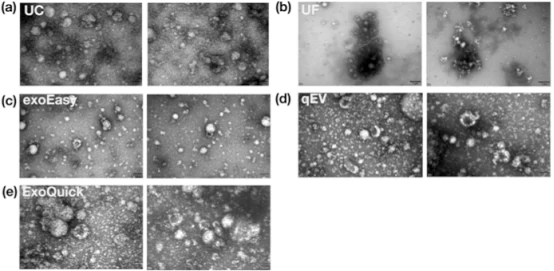
In this study, researchers conducted a detailed evaluation of five commonly used extracellular vesicle (EV) isolation techniques:
1、Traditional Differential Ultracentrifugation (UC): Ultracentrifugation refers to centrifugation speeds above 30,000 r/min. This method uses gradually increasing centrifugal forces to separate particles of different sizes and is widely regarded as the “gold standard” for isolating high-purity EVs from complex samples.
2、Ultrafiltration (UF): This technique employs semi-permeable membranes with micro-scale pores to achieve rapid and selective separation of EVs. It is particularly suitable for large-scale sample processing.
3、ExoEasy Membrane Affinity Method: This method uses membranes modified with affinity ligands to specifically bind and isolate EVs. It is simple to operate and convenient for routine workflows.
4、qEV Size-Exclusion Chromatography (SEC): Based on the principle of size-exclusion chromatography, this method separates components according to molecular size and is especially suitable for isolating uniformly sized EVs.
5、ExoQuick Polymer Precipitation: By adding high-molecular-weight polymers (such as PEG), this method alters the solubility and dispersibility of EVs, inducing their aggregation and subsequent precipitation via centrifugation. It is a rapid, user-friendly approach that is relatively gentle on EVs.
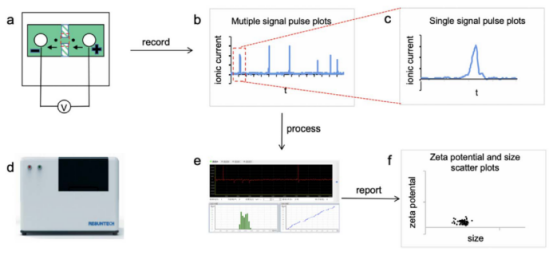
Resistive Pulse Sensing (RPS) is an emerging technology for single-nanoparticle characterization and currently the only particle analysis method based on electrical principles. By measuring changes in electrical current as individual extracellular vesicles pass through a nanoscale pore, RPS enables accurate assessment of their size, concentration, and zeta potential. With its advantages of precision, speed, simplicity, and high sensitivity, RPS has become an ideal tool for evaluating the quality of EV isolation methods.
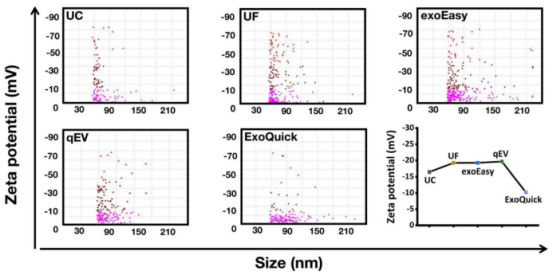
Evaluating Isolation Efficiency and Purity
Using RPS technology, the study analyzed the particle size distribution, concentration, and purity of EVs obtained through each method:
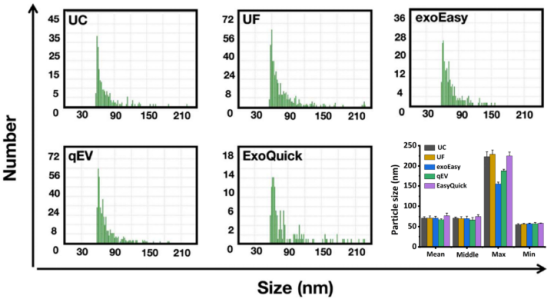
Particle Size Distribution: UC, UF, ExoEasy, and qEV methods yielded EVs with consistent sizes around 71 nm. In contrast, ExoQuick produced slightly larger vesicles, averaging 77 nm.
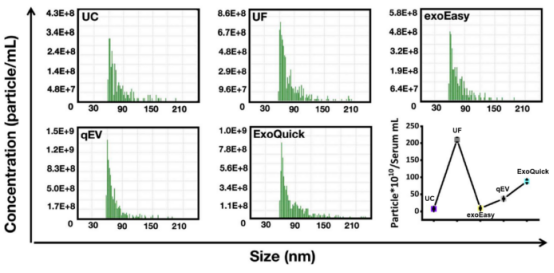
Particle Concentration: UF demonstrated the highest particle concentration at 2.10×10¹² particles/mL, whereas UC resulted in a lower concentration of 7.33×10¹⁰ particles/mL.
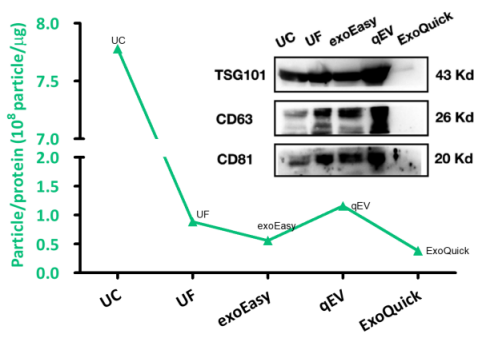
Purity: UC achieved the highest purity, with 7.88×10¹¹ particles per milligram of protein, indicating minimal protein contamination.
Selecting the Appropriate Isolation Method
Each isolation method has its own unique advantages. According to the study results, although differential ultracentrifugation is more time-consuming and technically demanding, it remains the preferred method when high-purity EVs are required. However, for applications that prioritize high efficiency and large-scale production, ultrafiltration and qEV size-exclusion chromatography offer faster separation and higher particle concentrations.
Advantages of NanoCoulter in EV Characterization
Single-Particle Detection – Precision Without Interference
Powered by advanced nanoscale RPS technology, the NanoCoulter delivers highly precise, individual particle analysis. Imagine each tiny EV passing through a nanopore in complex biological fluids undergoing a “full-body scan”—no signal is overlooked. Unlike traditional optical methods, which often miss smaller particles due to signal shielding by larger ones, NanoCoulter ensures true representation. Especially for polydisperse samples like EVs, every data point—be it size, concentration, or zeta potential—is derived from direct single-particle measurement, delivering reliable and authentic results. This unprecedented precision takes extracellular vesicle research to the next level.
High Precision & Multi-Parameter Analysis
NanoCoulter provides a comprehensive profile of EVs, including particle size, size distribution, concentration, and zeta potential. Accurate size distribution reveals the true variation in EV dimensions, while concentration reflects sample abundance and isolation quality. Zeta potential offers insights into vesicle stability and the drug-targeting efficiency of engineered EVs. This rich dataset offers a holistic understanding of EVs, empowering nanomedicine research and clinical translation with solid analytical support.
Adaptability to Complex Samples
Unlike traditional optical methods that analyze samples in bulk, NanoCoulter excels in characterizing polydisperse and challenging samples. It reliably detects nanoparticles in low-refractive-index, high-ionic-strength, or viscous fluids, ensuring consistent and accurate results—even in complex biological matrices. This makes it especially well-suited for biomedical research.
Rapid and User-Friendly Workflow
NanoCoulter is engineered for speed and simplicity. It requires no extensive sample pretreatment, no warm-up time, and no calibration by the end-user. Each nanopore chip is factory-calibrated and quality-verified, eliminating the need for standard samples during use. Researchers can obtain data faster and streamline their workflows, accelerating discovery.
Broad Application Versatility
NanoCoulter’s value extends far beyond EV research. With its high precision, robustness, and versatility, it has become an essential tool in fields like biomedicine, materials science, and environmental monitoring. Its powerful capabilities make it a trusted companion for researchers tackling nanoscale challenges across disciplines.
[1] Yang M, Guo J, Fang L, et al. Quality and efficiency assessment of five extracellular vesicle isolation methods using the resistive pulse sensing strategy. Anal Methods. 2024;16(32):5536-5544. Published 2024 Aug 15. doi:10.1039/d4ay01158a
