Characterization of Liposomes/LNPs
Liposomes are among the most extensively studied drug delivery vehicles, prized for their biocompatibility and biodegradability.
The Nanocoulter™ platform enables high-resolution, single-particle analysis of liposomes and lipid nanoparticles (LNPs), delivering precise measurements of particle size, concentration, and zeta potential.
This data supports process monitoring, size control, and quality assurance, while also facilitating in-depth studies on aggregation, stability, and storage conditions.
Nanocoulter™ is an essential tool for accelerating the development and production of liposomal drug formulations.

Sizing with TEM Accuracy. No TEM Required.
TEM data from different batches of liposome samples visually demonstrate the high precision, resolution, and accuracy of NanoCoulter™ detection.


Liposome Stability Study
The stability of liposomal drugs directly affects their storage and in vivo delivery performance. The NanoCoulter™ enables precise evaluation of stability differences among various liposomes. The figure below shows the concentration changes of two liposome samples after different durations of simulated agitation, indicating that Sample 2 exhibits superior stability.


Optimizing Liposome Manufacturing Methods
Different preparation methods can result in significant variations in liposome /LNPs particle size, making it essential to have a high-precision characterization method to guide the selection of the optimal production process. NanoCoulter can identify the most suitable preparation method. The figure below shows the particle size distributions of liposomes produced by four different methods. Method three demonstrates a uniform particle size distribution and higher concentration, outperforming the other three methods.


LNP Particle Size Distribution and Zeta Potential Analysis
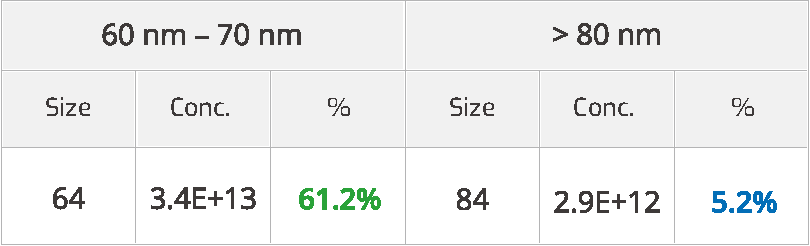
Particle size and size distribution are among the key Critical Quality Attributes (CQAs) parameters for LNPs. LNPs prepared by different methods may exhibit different size distributions, which are often overlooked by DLS measurements. The NanoCoulter™ can resolve the size distribution of LNP particle populations while providing concentration and component proportions within user-defined size ranges, along with the correlation between Zeta potential and particle size for each individual nanoparticle.